
Recoverability Bulletin #4
Your Cyber Insurer Has Already Priced Your Recovery Time
Once a year, the company that will pay for your worst day sends you a set of questions about how ready you are for it. Most organizations handle the cyber insurance renewal as paperwork. Risk management and the broker collect the answers, security confirms that MFA is on and the backups are running, and the application goes back with a column of yeses. A price comes back, and almost nobody reads it as feedback.
That price is feedback from an outside party with its own money on the line. The premium is that party’s estimate of how long your business will be down after an attack and what the outage will cost. Fenix24’s 2026 State of Recoverability Report shows carriers getting better at making that estimate, and organizations that can prove their recovery posture already pay less than organizations that can’t.
Losses rose and prices fell in the same year
By the NAIC’s count, U.S. cyber insurance claims rose almost 40% in 2024, to nearly 50,000. Average premium rates fell 5% in the fourth quarter, the first quarterly decline in seven years. Claims and prices can only move in opposite directions when the people setting prices trust themselves to tell good risks from bad ones. The NAIC credits the softening to sustained investment in the controls underwriters view favorably.
Seen that way, the average rate cut hides a split between buyers. Organizations that can show evidence of their security and recovery posture are buying better terms, higher limits, and lower retentions. Buyers who can’t show that evidence absorb more of the market’s rising losses through thinner coverage and larger retentions. The gap between the two groups is likely to widen as carriers get better at reading evidence. Proof of recovery has become a financial instrument, and its value shows up on every renewal.
What a $75 million payout still can’t buy
Carriers sort buyers this carefully because they know the limits of what their payouts accomplish. Many buyers learn those limits mid-incident, when the claim is moving and the business still isn’t. The payouts can be enormous. NetDiligence’s recent claims record includes extortion demands as high as $150 million, individual payments up to $75 million, and fifty separate ransoms of eight figures or more. Money on that scale moves capital to the victim and does nothing for the victim’s ability to recover.
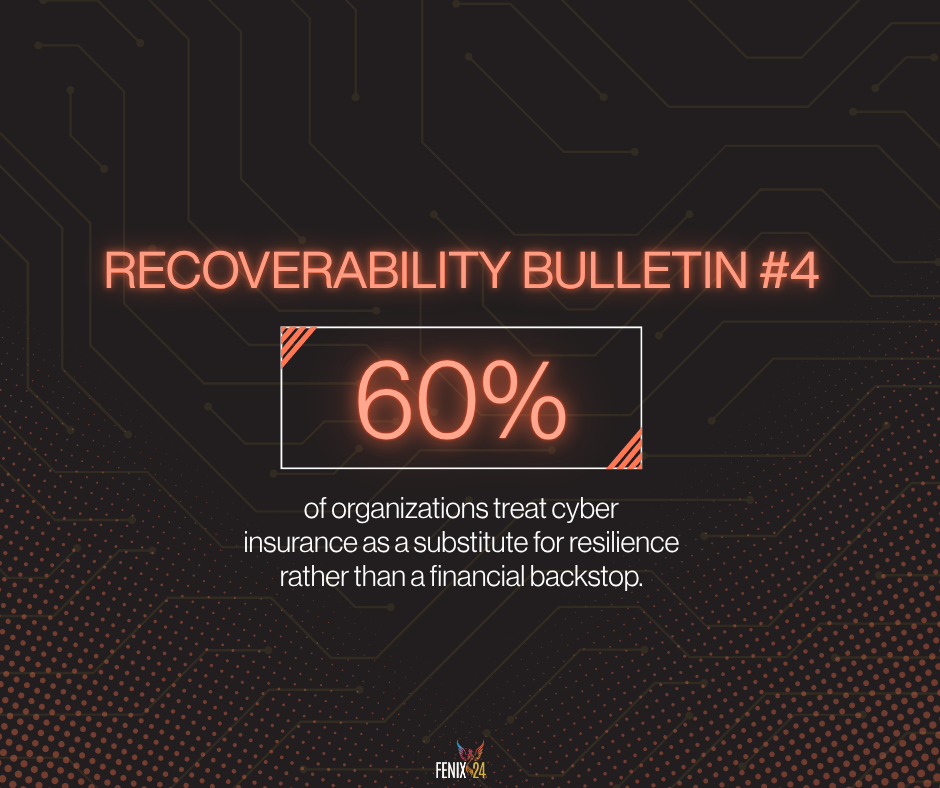
Even so, 60% of organizations treat cyber insurance as a substitute for resilience rather than a financial backstop, according to Accenture’s 2026 survey. The arithmetic works against them. Once downtime, lost revenue, and reputational damage are counted, total disruption costs can run ten times the payout, so in those incidents the policy covers about a tenth of the bill. Most of the uncovered remainder is downtime.
A policy restores capital after the claim is adjusted. It can’t bring back domain controllers or trust in a compromised identity plane, and it can’t produce a validated clean backup. It has no say in the order business services return, and it can’t buy back a single operating hour. Those are exactly the things a recovery team spends the first days of an incident fighting for. The reimbursement for those days arrives after they’re over.
The variable carriers price is time
Insurers know where their money goes. Business interruption is the majority of what they pay, according to both Allianz and Munich Re. Allianz reports that interruption losses scale with how well an organization executes response and continuity. Buyers who get back to operating quickly cost carriers less. The industry that prices this risk for a living has concluded that recoverability is the variable.
Recovery speed is set long before a claim is filed. The claim check funds the recovery but can’t speed it up. Recovery speed was fixed months earlier by three things: how well the backups survive an attack, how current the dependency map is, and whether a rehearsed restore path exists. By the time the recovery team joins the first call, those conditions are already in place or already missing. Money spent during the incident goes toward working around whatever is missing.
That puts insurance and recovery in the same budget conversation. Spending that shortens recovery lowers the loss a carrier is pricing, and underwriters return some of that value in better terms. Spending only on coverage buys reimbursement for downtime the organization has done nothing to shorten.
Bring the renewal into the recovery program
The State of Recoverability Report recommends reading renewal questionnaires as the market signal they are and using each renewal as a catalyst. The evidence underwriters now ask for and the evidence an actual recovery requires are the same evidence.
Acting on that changes who answers the application and what counts as an answer. Almost anyone can write “yes” next to “Are backups segregated from production?” because a yes on a form costs nothing to give. A backup environment that doesn’t authenticate through the production directory is something a carrier can price and a recovery team can use on the first day of an incident. Restore testing works the same way. A dated restore of a business service, timed against the RTO in the plan, tells the underwriter far more than a checked box. It also tells the CISO whether the recovery time in the plan is achievable. Fenix24 keeps that evidence current between renewals with Argos99, which models what each business service depends on, what backup coverage exists, what recovery sequence is required, and whether the plan’s recovery objectives can be met.
Moving the renewal into the recovery program also gives recovery work something it rarely has, a visible financial return. Hardening backups and mapping dependencies usually show up as cost with nothing offsetting them. At renewal, the CFO can see what the evidence was worth in premium and retention. That figure is easier to defend to a board than a lower probability of an attack that may not come this year.
Go into your next renewal with the evidence
The State of Recoverability 2026 pairs claims data from Allianz, research from the World Economic Forum, Accenture, and thirteen other institutions with Fenix24’s field data from more than 500 hands-on ransomware recoveries, the deepest body of recovery experience in the world. If you want to see what decides how long a business stays down, this is the evidence.
Click here to download Fenix24’s 2026 State of Recoverability Report.